聯合國氣候變化綱要公約第 31 屆締約方大會(COP31)在土耳其安塔利亞舉行,原訂11月20日閉幕,延長兩日仍因各國對化石燃料轉型等議題立場分歧,主決議「安塔利亞協議(Antalya Pact)」未能達成共識,未通過主要決議。雖然談判受挫,仍通過多項實質議程項目,全球氣候治理「從談判承諾走向具體落實」的趨勢不會改變。
環境部長彭啓明表示,臺灣不只是全球氣候行動的參與者,更要成為加速落實的推動者。臺灣願攜手國際社會與所有具減碳企圖心的國家,共同搭建雙邊與多邊碳市場,將減碳承諾轉化為可交易、可驗證、可投資的實質成果。臺灣也將以全球 AI 供應鏈核心的實力,協助各國以 AI 推展減碳與調適韌性的創新服務,讓氣候行動帶動產業升級、守護民眾生活。
彭部長指出,臺灣雖未能參與 COP 談判,卻是最著重落實的務實國家。「談判桌上沒有臺灣的位子,但在落實的行動清單上,臺灣從未缺席。」本屆大會以「落實」為核心,正是臺灣多年來的施政方向:不等國際共識,先以國內法制與政策工具付諸行動。從 NDC 3.0 核定、碳費實質徵收、自主減量計畫上路,到《資源循環推動法》法制化與國家都市林政策,臺灣以最高國際標準自我要求,把每一項承諾都化為可檢驗的數據與成果。
彭部長強調,國際間對 AI 算力能耗與治理規範尚未形成多邊具體共識,而臺灣身處全球 AI 供應鏈的製造核心,更有責任率先示範。臺灣以具體數據回應大會重點:國家淨排放量連續四年下降,十年來經濟成長與排放絕對脫鉤,證明減碳與經濟成長可以並行。臺灣也願意把這套經驗與世界分享。
在國際合作方面,彭啓明指出:「氣候危機沒有國界,沒有任何國家能獨自完成減碳。臺灣準備好了,願與世界各國並肩前行。」臺灣將從能源轉型、產業減量、甲烷管理、碳移除等領域,與夥伴國家共同發掘減碳合作機會。環境部已預告《國外減量額度認可準則》草案,並推進與巴拉圭的《巴黎協定》第六條試行專案,以透明、可信的碳市場促進技術投資與減量合作。未來將積極與更多夥伴國家洽談,拓展雙邊與多邊碳市場鏈結,並結合綠色成長基金與永續金融,支持氣候科技發展,擴大臺灣對全球減量的實質貢獻。
在 AI 創新服務方面,臺灣是全球 AI 伺服器的重要製造基地,具備資通訊與數位科技實力,將協助以 AI 推展減碳與調適韌性的創新服務,包括排放監測與盤查、能源管理優化、極端高溫與災害預警、城市綠化與韌性規劃等,並分享國內都市林圖資盤點、AI 高溫關懷等實務經驗,讓 AI 不只是用電大戶,更成為各國減碳與調適的關鍵工具。
在減碳成果方面,即使半導體與 AI 產業持續擴張,全球碳計畫(GCP)今年報告仍顯示,臺灣燃料燃燒二氧化碳排放已連續四年下降,2025年再減4.4%;2015至2025年間,我國實質GDP成長 47.6%,排放量卻絕對下降8.7%,是極少數能同時兼顧「高經濟成長」與「排放絕對下降」的國家,表現傲視多數先進經濟體。我國 NDC 3.0 設定2030年淨排放量較2005年減少28%±2%、2035年減少38%±2%,並以碳定價推動產業減量,碳費今年首度實質徵收49.7億元,其中半導體業負擔逾四成;已核定402 廠自主減量計畫預計2030年每年可減碳約4,520萬噸,並帶動減量設備投資約7,381.7億元。
在轉型脫離化石燃料方面,面對國際間對化石燃料轉型陷入分歧,臺灣支持轉型脫離化石燃料。我國《氣候變遷因應法》明定「應擬定逐步降低化石燃料依賴之中長期策略,訂定再生能源中長期目標」,確立推動轉型的法制根基。我國2025年核定之臺灣NDC 3.0 已提出「轉型脫離化石燃料」方向,載明「逐步落實既有燃煤機組降載與除役計畫,加大天然氣與再生能源取代燃煤之力度」「2020 年後不新增燃煤機組」,並針對未加裝減排設備之燃煤發電占比,設定「2030 年降至 20%、2035 年降至 9% 目標」,以明確量化指標階段性邁向減煤轉型。
在電氣化方面,COP31 大會提出明定 2035 年全球電力占最終能源消費達 35% 的電氣化目標,我國電力占國內能源消費比重已由 2010 年 27.4% 整體上升至今年前 9 月的 37.1%,未來持續推動運具電動化、建築節能與設備效率提升,結合潔淨能源、電網韌性、儲能設備及電動化基礎建設,持續優化我國電氣化環境,兼顧減碳與空氣品質改善。
在用 AI 守護氣候方面,環境部推動國家都市林政策,規劃以科學圖資、大數據與數位孿生等科技,盤點高溫熱區的綠蔭缺口、植栽適地性與敏感族群分布,據以劃定優先綠化區位,呼應 COP31 推動的韌性城市。環境部也與臺南市政府試辦「酷齡氣候關懷行動」,結合 AI 預測室內溫度,於高溫風險升高時即時通知社福人員關懷訪視獨居長者,以「科技找風險、人力送關懷」守護高溫下的脆弱族群。
在碳捕捉、利用及封存(CCUS)方面,COP31提出全球應增加推動CCUS技術部署,以2035年達到每年10億噸級規模為共同願景,並鼓勵產業擴大技術研發與應用,特別針對難減排產業。我國已提出CCUS 減碳旗艦行動計畫,以2035年每年600萬噸CO₂為目標,與全球腳步一致,並兼顧減碳目標與環境永續來推動。
在甲烷與循環經濟方面,呼應 COP31 大會倡議將零廢棄(Zero Waste)與甲烷減量列為行動核心,我國甲烷排放已由 2005 年的 11.428 百萬公噸 CO₂e 降至 2024 年的 4.345 百萬公噸 CO₂e,已大幅減少約 62%,減量績效優於多數國家,主要來自垃圾分類減量、廢污水納管與畜牧沼氣回收發電。環境部推動《資源循環推動法》法制化,從源頭減量、再生材料使用及產業循環,降低資源耗用與排放,並以 2020 年為基準,提出 2050 年資源生產力提升至 2 倍、人均物質消費量減少 35%、投入端循環利用率提升至 2.5 倍的目標,帶動循環產業商機。未來太陽光電板、資料中心伺服器等新興設備的回收再利用,也將成為循環經濟的發展方向。
臺灣高度重視 COP31 主席國所倡議的零廢棄與循環經濟方向,並將資源循環視為推動淨零轉型、強化資源安全及提升產業競爭力的重要策略。臺灣不僅將持續深化國內循環經濟政策,也願意分享多年累積的資源回收、技術創新及產業發展經驗,積極與國際夥伴合作,共同推動循環材料應用及跨境循環供應鏈,讓循環經濟成為全球氣候行動與綠色成長的新動力。
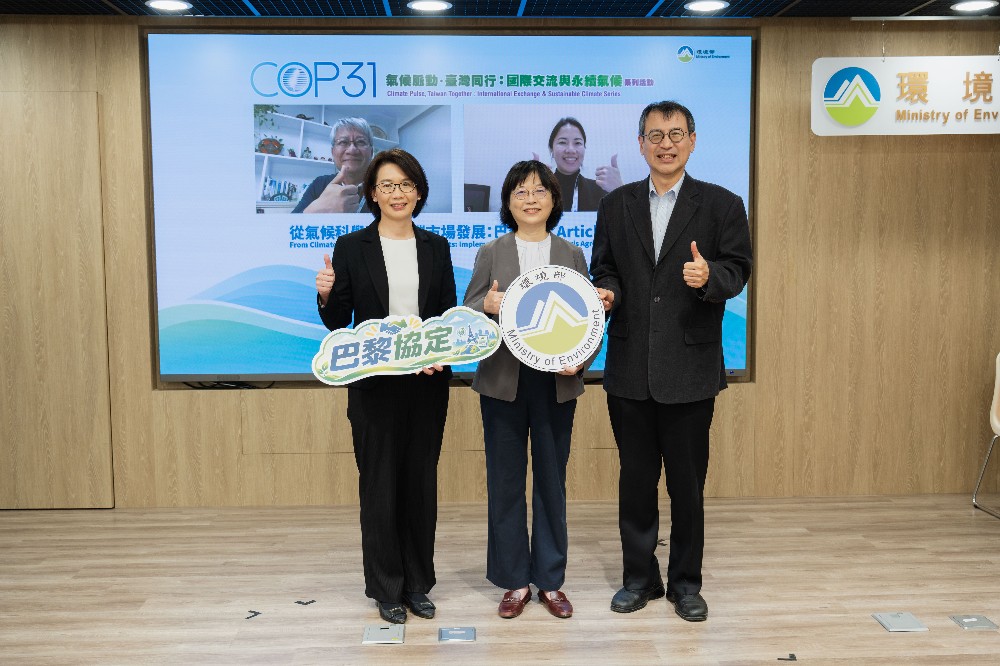
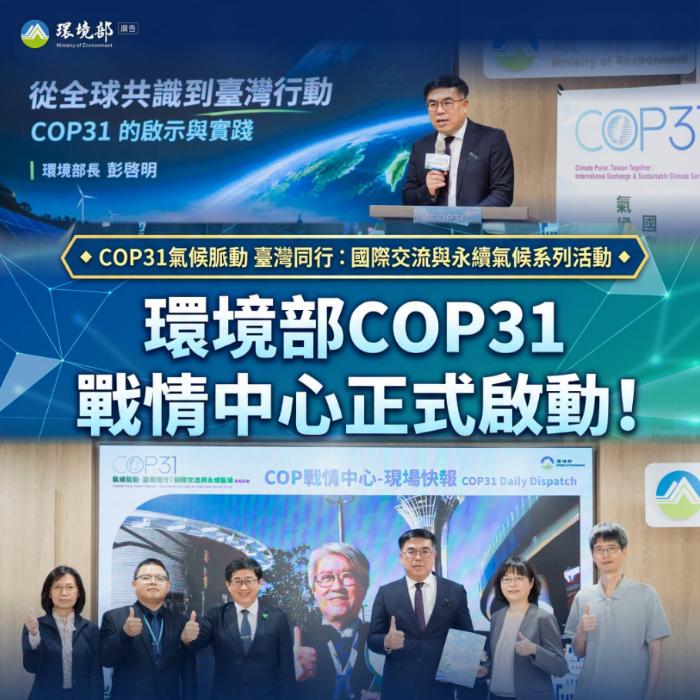
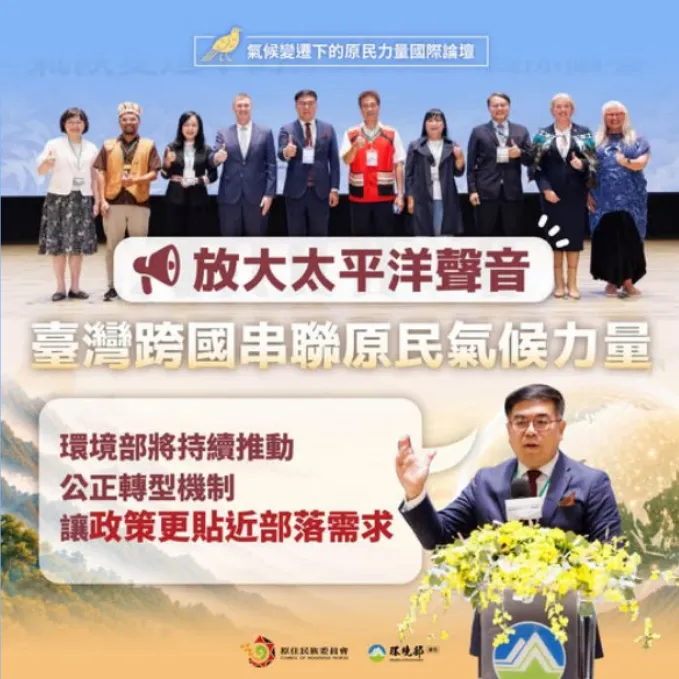
環境部於大會期間開設 COP31 戰情中心,舉辦「氣候脈動.臺灣同行」系列活動共 10 場論壇,串連綠色金融、AI、碳移除、公正轉型與青年參與,將國際交流轉化為國內政策行動。針對本次 COP31 會議所強調調適與公正轉型方向,臺灣正持續推進國土綠蔭、都市林與高溫調適,已串聯全國超過 1 萬處涼適點,並完成 40 度高溫情境實兵演練。公正轉型也已納入《氣候變遷因應法》,透過跨部會協作、社會對話及溫管基金專款,支持勞工、原住民族與受影響群體參與轉型。
【No Consensus at COP31: Taiwan Moves Forward with Accelerated Implementation, Partnering Internationally to Advance Carbon Markets, Circular Economy, and AI-Driven Climate Resilience】
The 31st Conference of the Parties to the United Nations Framework Convention on Climate Change (COP31) took place in Antalya, Türkiye. Originally scheduled to conclude on November 20, the summit was extended by two days; however, due to divergent positions among countries on issues such as the transition away from fossil fuels, consensus could not be reached on the overarching resolution, the “Antalya Pact,” and the summit concluded without adopting a primary resolution. Despite the setback in negotiations, several substantive agenda items were adopted, reaffirming that the global climate governance trend of “moving from negotiated commitments to concrete implementation” remains irreversible.
Minister of Environment Chi-Ming Peng stated that Taiwan is not merely a participant in global climate action, but an active driver accelerating its implementation. Taiwan stands ready to collaborate with the international community and all ambitious nations to jointly establish bilateral and multilateral carbon markets, translating climate pledges into tradable, verifiable, and investable tangible outcomes. Leveraging its core strength in the global AI supply chain, Taiwan will also assist countries worldwide in utilizing AI to advance innovative decarbonization and climate resilience services, ensuring climate action drives industrial upgrading while safeguarding public well-being.
Minister Peng noted that although Taiwan was unable to participate directly in the COP negotiations, it remains one of the most pragmatic nations dedicated to practical execution. “While Taiwan may not have a seat at the negotiation table, Taiwan has never been absent from the action checklist.” With this conference centered on “implementation,” it aligns precisely with Taiwan’s long-standing policy direction: not waiting for international consensus, but taking immediate action through domestic legal frameworks and policy tools. From the approval of NDC 3.0, the collection of carbon fees, and the rollout of self-determined reduction plans, to the legislation of the Resource Circulation Promotion Act and the National Urban Forestry Policy, Taiwan holds itself to the highest international standards, turning every commitment into verifiable data and concrete results.
Minister Peng emphasized that while multilateral consensus has yet to form regarding AI compute energy consumption and governance standards, Taiwan—positioned at the manufacturing heart of the global AI supply chain—has a distinct responsibility to lead by example. Taiwan responds to the key focal points of the summit with concrete data: national net emissions have declined for four consecutive years, and over the past decade, economic growth has achieved absolute decoupling from carbon emissions, demonstrating that emissions reduction and economic expansion can proceed hand in hand. Taiwan is eager to share this experience with the world.
Regarding international cooperation, Peng pointed out: “The climate crisis knows no borders, and no single nation can achieve decarbonization alone. Taiwan is ready to walk shoulder-to-shoulder with countries across the globe.” Taiwan will explore collaborative mitigation opportunities with partner nations across sectors including energy transition, industrial decarbonization, methane management, and carbon removal. The Ministry of Environment has announced the draft Regulations Governing the Recognition of Overseas Mitigation Outcomes and is advancing an Article 6 pilot project under the Paris Agreement with Paraguay, fostering technology investment and mitigation cooperation through a transparent and credible carbon market. Moving forward, Taiwan will actively engage with more partner nations to expand bilateral and multilateral carbon market links, while combining green growth funds and sustainable finance to support climate technology development and amplify Taiwan’s tangible contributions to global emissions reduction.
In terms of AI innovation services, as a critical manufacturing hub for global AI servers equipped with advanced ICT and digital capabilities, Taiwan will help drive innovative services for emissions reduction and adaptation resilience. These applications encompass emissions monitoring and inventorying, energy management optimization, extreme heat and disaster early warning systems, and urban greening and resilience planning. Taiwan will also share practical domestic experiences—such as urban tree canopy mapping and AI-assisted heat vulnerability care—ensuring that AI is transformed from an energy-intensive sector into an indispensable tool for climate mitigation and adaptation worldwide.
Regarding emissions reduction achievements, despite the ongoing expansion of its semiconductor and AI sectors, the Global Carbon Project (GCP) report this year indicates that Taiwan’s CO₂ emissions from fossil fuel combustion have declined for four consecutive years, with an additional 4.4% reduction in 2025. Between 2015 and 2025, Taiwan’s real GDP grew by 47.6% while total emissions dropped in absolute terms by 8.7%, making it one of the rare nations to simultaneously achieve high economic growth and absolute emissions reduction—a performance surpassing many advanced economies. Under its NDC 3.0, Taiwan targets a net emissions reduction of 28% ± 2% by 2030 and 38% ± 2% by 2035 compared to 2005 levels. To incentivize industrial decarbonization through carbon pricing, carbon fees were formally collected this year totaling NT$4.97 billion, with the semiconductor sector contributing over 40%. Furthermore, approved self-determined
reduction plans across 402 facilities are projected to reduce approximately 45.2 million metric tons of CO₂ annually by 2030, driving capital expenditures in mitigation equipment of around NT$738.17 billion.
In terms of transitioning away from fossil fuels, while international discussions remain divided, Taiwan firmly supports transitioning away from fossil fuels. Taiwan’s Climate Change Response Act clearly mandates the formulation of medium- and long-term strategies to phase down fossil fuel dependency and the setting of renewable energy milestones, establishing a solid legal foundation for this transition. Approved in 2025, Taiwan’s NDC 3.0 explicitly sets the course for transitioning away from fossil fuels, detailing plans to “progressively implement capacity reduction and decommissioning of existing coal-fired units, significantly accelerate the substitution of coal with natural gas and renewable energy,” and “cease the commissioning of new coal units after 2020.” Furthermore, Taiwan has set specific quantitative targets to reduce the share of unabated coal-fired power generation to 20% by 2030 and 9% by 2035, steering a phased and decisive coal phase-down.
In terms of electrification, the COP31 resolution explicitly established a global electrification goal of increasing the share of electricity in total final energy consumption to 35% by 2035. Taiwan’s share of electricity in domestic final energy consumption has risen steadily from 27.4% in 2010 to 37.1% in the first nine months of this year, surpassing the global benchmark ahead of schedule. Moving forward, Taiwan will continue advancing transport electrification, building energy efficiency, and equipment optimization, integrating clean energy, grid resilience, energy storage, and electrification infrastructure to optimize the national electrification landscape while cutting carbon emissions and improving air quality.
On leveraging AI for climate protection, the Ministry of Environment is advancing the National Urban Forestry Policy. Utilizing scientific spatial data, big data, and digital twin technologies, the initiative maps urban heat islands to identify canopy gaps, planting suitability, and vulnerable populations, thereby designating priority greening zones to support COP31’s vision for resilient cities. Additionally, the Ministry has partnered with the Tainan City Government to pilot the “Cool Age Climate Care Initiative,” utilizing AI indoor temperature predictions to promptly notify social workers during elevated heat risks to conduct home visits for seniors living alone—putting into practice the principle of “leveraging technology to identify risks, mobilizing human care to protect vulnerable communities.”
Regarding Carbon Capture, Utilization, and Storage (CCUS), the COP31 resolution urges the global community to accelerate the deployment of CCUS technologies, establishing a collective vision of reaching a scale of 1 billion metric tons annually by 2035, while encouraging industries—especially hard-to-abate sectors—to scale up R&D and deployment. In alignment with global progress, Taiwan has launched its CCUS Decarbonization Flagship Action Plan, targeting an annual capacity of 6 million metric tons of CO₂ by 2035, advancing carbon reduction goals alongside environmental sustainability.
In terms of methane and the circular economy, echoing the COP31 initiative designating Zero Waste and methane reduction as core priorities, Taiwan’s methane emissions fell from 11.428 million metric tons CO₂e in 2005 to 4.345 million metric tons CO₂e in 2024—a reduction of approximately 62%. This performance outperforms most nations and is primarily attributed to waste sorting and reduction, municipal wastewater interception, and agricultural biogas recovery for power generation. Concurrently, the Ministry of Environment is enacting the Resource Circulation Promotion Act to curb resource consumption and carbon emissions through source reduction, recycled material integration, and industrial symbiosis. Using 2020 as a baseline, Taiwan aims to double resource productivity, reduce per capita material consumption by 35%, and increase input-side circular utilization rates to 2.5 times the baseline by 2050, fostering substantial business opportunities in the circular sector. The recovery and high-value recycling of emerging equipment, such as solar photovoltaic panels and data center servers, will also represent a key frontier for circular economy development.
Taiwan places high importance on the Zero Waste and circular economy agenda championed by the COP31 Presidency, regarding resource circulation as an essential pillar for advancing net-zero transition, enhancing resource security, and boosting industrial competitiveness. Taiwan will not only continue to deepen domestic circular economy policies, but also actively share its decades-long experience in resource recycling, technological innovation, and industrial development. Taiwan looks forward to partnering with international counterparts to co-develop circular material applications and cross-border circular supply chains, establishing the circular economy as a new engine for global climate action and green growth.
During the conference, the Ministry of Environment operated the COP31 War Room and hosted the “Climate Pulse: Taiwan Together” series comprising 10 forums. These sessions linked green finance, AI, carbon removal, just transition, and youth engagement, effectively translating international dialogue into domestic policy actions. Addressing the conference’s focus on adaptation and just transition, Taiwan continues to enhance national canopy cover, urban forestry, and heat adaptation, having linked over 10,000 cooling stations nationwide and completed full-scale simulation drills for 40°C extreme heat scenarios. Furthermore, just transition has been formally integrated into the Climate Change Response Act, supported by inter-ministerial collaboration, social dialogue, and the Greenhouse Gas Management Fund to empower workers, indigenous peoples, and impacted communities throughout the transition.